
Why High Volume Keywords Are Wrong for New AI Sites (And What to Chase Instead)
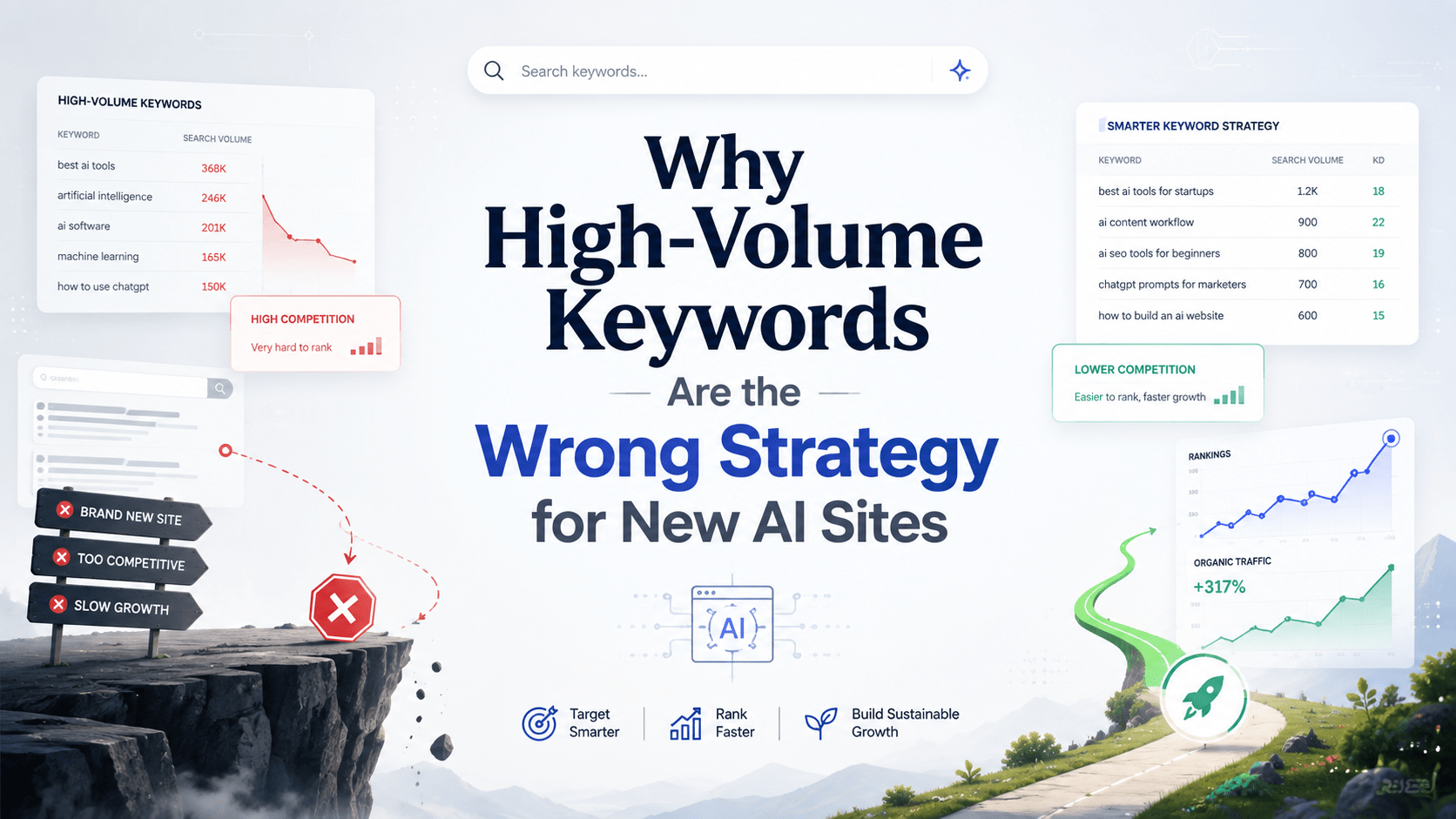
Here’s a number that should stop you in your tracks: in Google’s newer AI Mode, the zero-click rate reaches a staggering 93%, meaning almost nobody clicks through to a website even when your content technically “wins” the query. That’s the blunt reality behind why high volume keywords are wrong for new AI sites in 2026, and it’s a lesson we learned the hard way while building out our own AI tools and affiliate resources.
The goal is simple: help you build smarter content systems using AI, instead of chasing vanity numbers that don’t convert into visitors, subscribers or sales.
Key Takeaways
| Question | Quick Answer |
|---|---|
| Why are high volume keywords wrong for new AI sites? | AI Overviews now answer most broad queries directly, so even a top position rarely earns a click for a brand-new domain. |
| What should new sites target instead? | Long-tail, specific phrases with real buying or learning intent, found using a proper keyword research tool. |
| Do keyword research tools still matter in 2026? | Yes. A good keyword search tool helps you spot low-competition, high-intent phrases that AI summaries tend to skip. |
| How fast do AI Overviews affect click-through rate? | Organic click-through can fall from around 1.76% to just 0.61% once an AI Overview appears above the results. |
| Is niche targeting better than volume for new sites? | Almost always, especially for sites with little authority yet. |
| Where can beginners learn this properly? | Start with our free learning resources before spending money on tools. |
| What’s the one clear starting move? | Pick one keyword research tool, one topic cluster, and one clear goal. |
Why High Volume Keywords Are Wrong for New AI Sites From Day One
New sites have almost no authority. Zero trust signals, zero history, zero backlinks worth mentioning.
High volume keywords are dominated by established brands, huge publishers, and now, AI-generated summaries that answer the question before anyone scrolls down. This is exactly why high volume keywords are wrong for new AI sites: you’re not just competing against other websites anymore, you’re competing against the answer box itself.
Think about what actually happens when someone searches a broad, high-volume term. The AI Overview appears at the top of the page. It gives a clean, confident answer. The person reading it gets what they need and closes the tab.
That’s the whole session. No scrolling, no clicking, no visit to your carefully written page.
What Happens When AI Overviews Eat Your Traffic
We’ve watched this shift happen fast. AI Overviews aren’t a niche experiment anymore, they’re becoming the default experience for most searches.
The prevalence of AI Overviews has nearly tripled in a single year, and 88% of the searches that trigger them are informational, which happens to be exactly the type of high-volume keyword a new AI site would naturally target first. That’s not a coincidence. Broad, “what is” and “how does” style keywords are the easiest for an AI system to summarise cleanly.
On mobile devices specifically, AI Overviews and featured snippets now consume 75% of the screen. Your listing, even if you rank, is pushed so far down the page that most visitors never see it at all.
- Broad informational searches get summarised instantly.
- Mobile results push organic listings below the fold almost entirely.
- Ads now appear in roughly a quarter of AI Overview results, crowding the space even further.
- Publishers report traffic drops of 50% or more directly tied to AI summaries answering the question first.
The Real Cost of Chasing Big Search Volume
Chasing search volume feels productive. Big numbers look impressive on a spreadsheet.
But volume without intent is a trap, especially for a site that’s brand new and has nothing to fall back on when the click-through rate collapses.
That drop applies even to pages that earn a top spot. Now imagine a brand-new site with no track record trying to compete for the exact same phrase.
This is the core reason why high volume keywords are wrong for new AI sites right now. The prize at the top of the mountain has shrunk, and the climb is harder than ever.
How a Keyword Research Tool Actually Helps New Sites
None of this means keyword research is dead. It means the way you use a keyword research tool needs to change.
Instead of typing in a broad term and chasing the biggest number on the screen, use your keyword research tool to dig for the questions underneath the obvious search. Every good keyword tool shows related searches, “people also ask” style prompts, and long-tail variations that carry far less competition.
The aim is not to chase every trending phrase or big-volume trap. The aim is to find tools and workflows that are actually useful for a site still building its first bit of trust.
A few things worth checking whenever you run a keyword search tool:
- How many words are in the phrase? Longer usually means more specific intent.
- Does the phrase read like a real question a person would ask?
- Is there an AI Overview already dominating that exact phrase?
- What does the competition actually look like, not just the difficulty score?
SEO Keyword Analysis Tools vs Chasing Big Numbers
There’s a difference between an seo keyword analysis tool that helps you understand intent and one that simply hands you a volume number and calls it a day.
Volume alone tells you almost nothing useful in 2026. A term with 50,000 monthly searches and an AI Overview sitting on top of it is often worth less than a term with 200 searches and zero AI summary competing for attention.
The goal is simple: find where people still need to click through to get their answer, not where the answer already lives on the search page.
Good seo tools for keyword research in 2026 should show you AI Overview presence, question-based variations, and the actual shape of the results page, not just a raw number pulled from an old database.
Long-Tail Keywords: The Actually Useful Alternative
Long-tail phrases are longer, more specific, and far less glamorous than the big broad terms everyone wants to rank for. They’re also where new sites actually win.
A phrase like “best beginner niches for affiliate marketing in 2026” carries a fraction of the volume of “affiliate marketing.” But it also carries real, specific intent, and it’s far less likely to be swallowed whole by an AI summary.
This is the same logic we apply across our own site. Rather than fighting for the word “affiliate marketing” outright, we built out specific guides like our top affiliate marketing niches resource and our affiliate marketing side hustle guide, each one answering a narrower, more useful question.
Click-through rate falls from 1.76% to just 0.61% when chasing big keywords.
Choosing the Right Keyword Search Tool for Your Niche
There’s no shortage of keyword tools out there. What matters is picking one that fits how you actually work, and using it properly.
We keep a running collection of tools we’ve tested ourselves inside our AI tools directory, and a keyword research tool is only as good as the workflow built around it. A brilliant kw research tool used carelessly will still point you toward the same overcrowded, AI-dominated terms if you let it.
That number alone should reframe how you use any keyword keyword research tool going forward. It’s not about ranking for the biggest word in your niche. It’s about earning one of those 360 remaining clicks.
Our Approach: One Tool, One Workflow, One Clear Goal
Instead of spending hours searching through tools, platforms and strategies, we bring useful resources together in one place. That’s the whole point of KobaBox.
The aim is not to chase every new tool or trend that shows up in your inbox. The aim is to help you find tools and workflows that are actually useful, specifically for sites that are still new and still building trust.
Start with one keyword research tool. Pick one topic cluster built from long-tail phrases. Set one clear goal, whether that’s traffic, email signups, or affiliate clicks.
If you’re weighing up whether affiliate content is even worth the effort in this AI-heavy climate, our breakdown on whether affiliate programs are still worth it is a good next stop.
How to Build a Keyword Plan That Survives AI Overviews
Here’s the practical, step-by-step version of everything above.
- Open a keyword research tool and search your core topic, but ignore the volume column at first.
- Filter for question-based and multi-word phrases that read like something a real person would type or say to an AI assistant.
- Check for an existing AI Overview on each phrase before committing to write about it.
- Group related long-tail phrases into a single, thorough page rather than spreading thin content across dozens of pages.
- Track clicks, not just impressions, since impressions mean nothing if nobody is clicking through.
- Revisit the list monthly using the same seo keyword research tools, because AI Overview coverage keeps expanding.
This approach applies whether you’re running a content site, a product page, or an affiliate resource like our affiliate marketing website guide. Specific, consistent, question-led content beats broad guesswork every time.
Signs You’re Still Chasing the Wrong Keywords
A few red flags worth checking on your own site right now:
- Your top pages target single-word or two-word phrases with massive stated volume.
- An AI Overview already answers the exact question your page is built around.
- Your impressions are climbing but clicks are flat or falling.
- You picked the keyword because the number looked big, not because you checked the results page first.
If two or more of those sound familiar, it’s worth going back through your keyword tool and re-filtering for longer, sharper phrases.
Conclusion
Why high volume keywords are wrong for new AI sites boils down to one simple truth: the biggest numbers now belong to AI Overviews, not to new websites without history or trust.
Dream Big, Start Small, Act Now, and make Daily Progress toward long-tail phrases that still send real people to your page. Pick one keyword research tool, build around one clear topic cluster, and let consistent daily action do the rest.
Simply understanding why high volume keywords are wrong for new AI sites in 2026 puts you ahead of most people still guessing their way through a keyword list.
Frequently Asked Questions
Why are high volume keywords bad for new websites in 2026?
High volume keywords are wrong for new AI sites because AI Overviews now answer most broad questions directly on the results page, leaving little to no traffic for a site with no established authority.
What keyword research tool should beginners use first?
Start with any keyword research tool that shows AI Overview presence alongside search volume, since volume alone no longer tells you whether a click is actually available.
Do long-tail keywords still work in 2026?
Yes, long-tail keywords work better than ever, precisely because they carry specific intent that AI summaries are less likely to fully satisfy on the search page itself.
How much traffic do AI Overviews really take away?
Reported drops vary, but publishers have seen organic click-through fall by more than half on pages that used to perform well before AI Overviews appeared.
Is it worth using an SEO keyword analysis tool for a brand-new site?
Absolutely, but the tool matters less than how you use it. Filter for question-based, longer phrases instead of the highest volume terms on the list.
Can a new AI site ever compete for high volume keywords?
Eventually, once the site builds authority and trust signals, but starting there is one of the most common mistakes new sites make.
What’s the simplest way to start a keyword plan today?
Pick one keyword search tool, one narrow topic cluster built from long-tail phrases, and one clear goal, then take consistent daily action from there.

- High-Ticket & Recurring Affiliate Workflows: A Practical 2026 How-To for Predictable Commissions - August 31, 2026
- Faceless YouTube Tool Matrix: AI Video Generators Compared - August 10, 2026
- Why High-Volume Keywords Are the Wrong Strategy for New AI Sites - August 10, 2026